
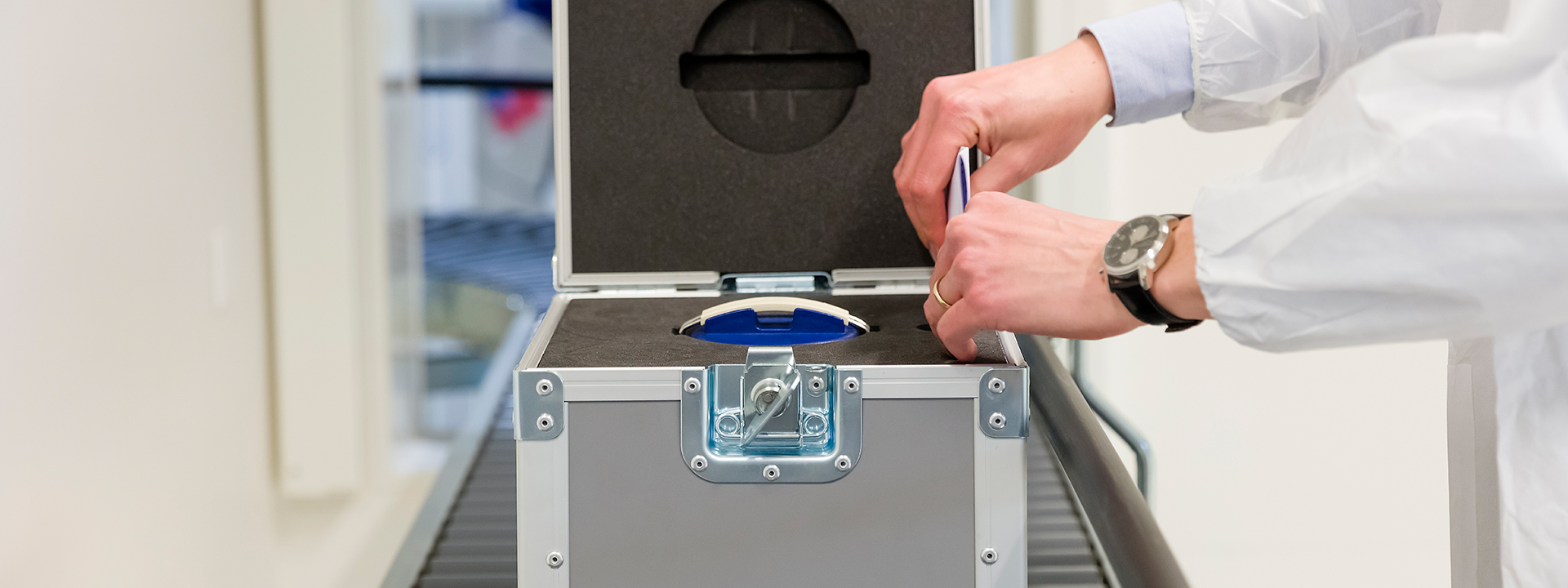
Understanding what you are transporting
The radiation intensity of an isotope determines the type of shielding. For low initial activity or low energetic decay, a lead container is often suitable. When there is high initial activity or high-energy decay (such as gamma emission), more shielding is required.
More shielding can also be achieved by using a material with a higher density, such as tungsten. In the comparison of tungsten vs lead, tungsten provides higher shielding at the same material thickness.
At Von Gahlen, we are happy to share our knowledge about the different possibilities. With our experience in radiopharmaceutical packaging, we help organizations make the right choices for their specific application.
Want to know more about our approach? Read more in our blog to learn how we can support your radioactive transport needs.

Two types, each with its own application
Tungsten container: robust, closed design, high shielding
The orange-blue tungsten container is used for shipments that require a high level of shielding. The compact design is suitable for vials, and thanks to the closed housing and sturdy flight case, this packaging is suitable for international air and road transport. The tungsten container is:
- Robust and designed for intensive reuse
- Suitable for radioactive materials with high activity
- Certified for worldwide transport
Lead containers: multiple types depending on application
Von Gahlen supplies different types of lead containers, each with a specific application. The blue-white container, comparable in design to the tungsten container, is suitable for reuse. In addition, there are lead containers (such as the VG-LP series) that are suitable for single use and are recyclable. The lead container is:
- Available in multiple versions (multi-use or single-use) and sizes
- Suitable for isotopes with lower activity
- Efficient for shorter distances or distribution within national borders
- Certified for Type A transport according to SSR-6